Most Denver moves don't line up perfectly. Your lease ends on the 31st, the new place isn't ready until the 5th, and suddenly you've got a household with nowhere to live for a week. Storage during a move in Denver is how families bridge that gap without renting two homes at once. We've handled this thousands of times across the metro, from a LoHi apartment swap to a downsizing move out of Highlands Ranch, and the right storage plan usually saves money and a lot of stress. In this guide we'll walk through when you actually need storage, the main options and what they cost, why our dry mile-high air changes the math on climate control, and how we coordinate transport and storage so your belongings get handled once instead of three times.
Table of Contents
- When You Actually Need Storage During a Denver Move
- Short-Term vs. Long-Term: How Long Will You Really Need It
- Your Three Main Storage Options, Compared
- Why Climate Control Matters More at 5,280 Feet
- How to Pack and Prep for Storage the Right Way
- Security, Licensing, and What to Verify Before You Book
- How ELM Coordinates Your Move and Storage Together
- Frequently Asked Questions
When You Actually Need Storage During a Denver Move
Storage isn't only for hoarders or cross-country jobs. The most common reason we hear in Denver is plain timing. Lease turnover peaks from May through August, so a new rental often opens up days or weeks after your old one closes out. Home buyers run into the same squeeze in a competitive market, selling before they buy and needing a short bridge between closing on the old place and getting keys to the new one. A week or two of storage covers that gap cleanly instead of forcing a same-day double move.
Staging and downsizing: If you're listing your home, pulling out extra furniture makes rooms show larger and photograph better, which usually means more showings. We'll store the overflow until you close. Downsizers face a different version of this, whether it's empty-nesters leaving a four-bedroom in Centennial for a Cherry Creek condo or a family trimming down before a long-distance move. You hold the maybes in storage and decide what stays once you're settled, instead of cramming everything into a smaller space on day one.
- •Lease gap: old place ends before the new one is ready (most common in peak summer)
- •Sell-before-you-buy: a short bridge between closing and possession
- •Home staging: store excess furniture so your listing shows decluttered
- •Downsizing: hold the overflow until you decide what to keep
- •Relocating into Denver: a holding point while housing gets finalized
- •Renovation: clear rooms while floors, paint, or kitchens get done
Short-Term vs. Long-Term: How Long Will You Really Need It
The split is simple in practice. Short-term storage covers a closing or lease gap and usually runs a few days to about 60 days. Long-term storage is anything past a couple of months, common during a long renovation, an extended relocation, or a downsizing decision you're not ready to make. The distinction matters because it changes the right product and the right billing. For a short gap, paying a full month at a self-storage place can be wasteful. For a long hold, a sealed vault often beats a monthly unit on both cost and handling.
The free-window angle: Many full-service movers, us included, build in a no-charge storage window before per-vault monthly billing begins. So a true short-term gap can sometimes cost you nothing in storage fees, only the moving labor on each end. Ask about that window when you get your quote, because it changes which option is cheapest for your timeline. If you genuinely don't know how long you'll need, plan for the longer estimate. Extending storage is easy. Scrambling to find a unit in July is not.
Quick gut check on timeline
- •Under 2 weeks: ask about a free storage window before renting anything
- •2 to 8 weeks: short-term; portable container or vault storage usually wins
- •2 to 6 months: long-term; vault storage or a climate-controlled unit
- •6+ months: prioritize climate control and security over the lowest sticker price
- •Always pad your estimate by a week. Denver closings and lease handoffs slip
Your Three Main Storage Options, Compared
There are three realistic ways to store belongings during a move, and they differ mostly in who does the lifting and how many times your stuff gets handled. Self-storage means you rent a unit and move things in and out yourself (or pay movers to). Portable containers get dropped at your curb, you load them, and the company hauls them off. Full-service vault storage means our crew wraps, pads, and loads your items into sealed wooden vaults that live in a secured warehouse, and you never visit the facility.
Self-storage units
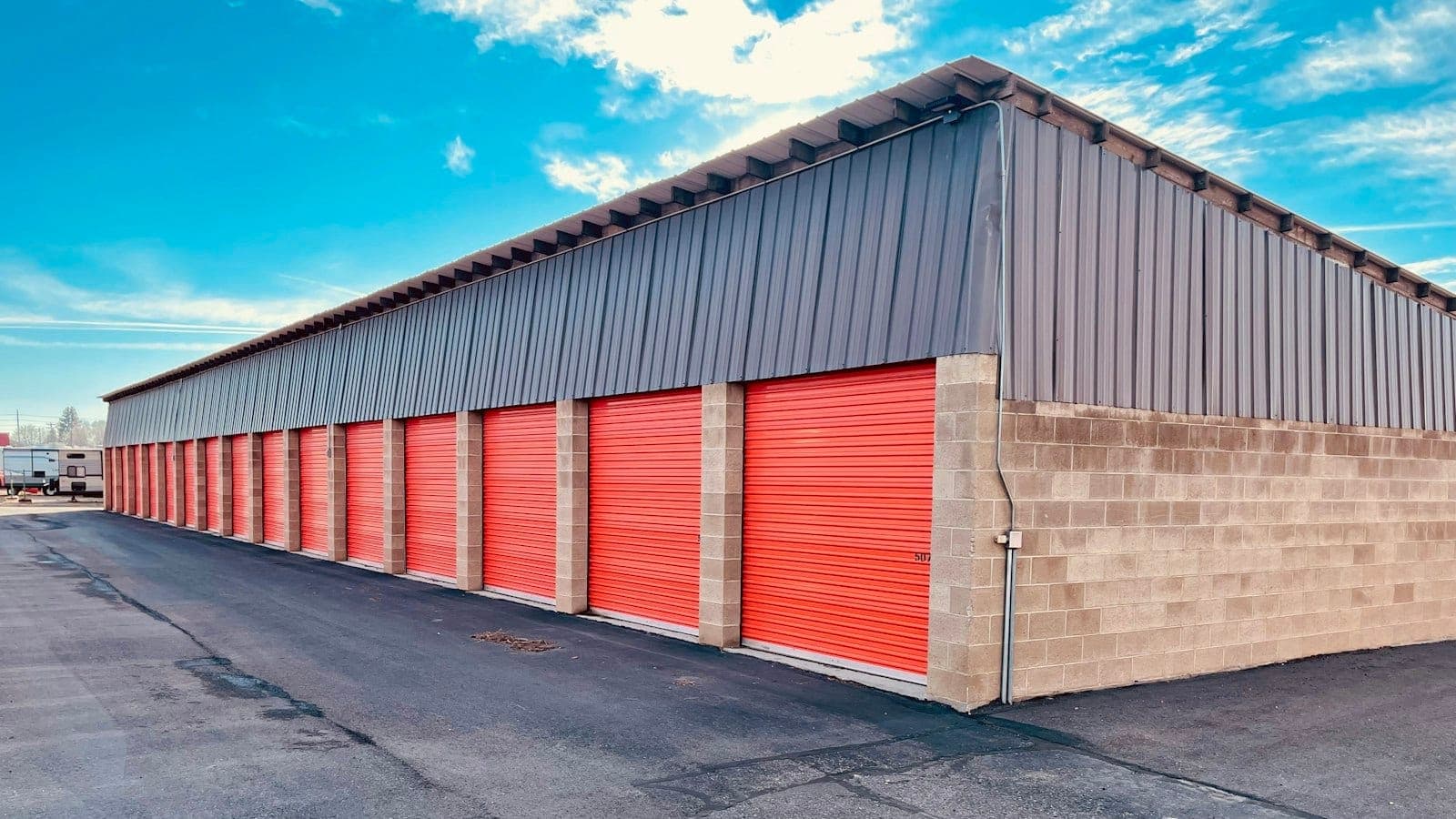
Self-storage is the familiar option: a gated facility with row after row of roll-up doors. In Denver a 10x10 unit averages roughly $99 to $131 a month, with budget or outdoor units starting closer to $31 to $60. A 10x10 holds about a one to two bedroom apartment, or roughly three rooms of furniture. It's flexible and you control access, but it forces double-handling. Your things get loaded, unloaded into the unit, then loaded and unloaded again at the new place. Summer availability tightens and rates climb right when lease-gap demand spikes.
Portable containers
Portable containers (the PODS-style boxes) split the difference. A container gets dropped at your home, you load it on your own schedule, and the company stores or delivers it. In Denver expect monthly rental commonly around $139 to $270, plus delivery and pickup near $80 each way, so all-in often lands around $150 to $350 a month. They're handy for slow-paced loading and for HOA-friendly neighborhoods that allow a container in the driveway for a few days. Check your suburb's rules first, since some Front Range HOAs limit how long a container can sit.
Full-service vault storage
Full-service vault storage is what we most often recommend for a move-and-hold. Each sealed wooden vault is about 5x7x7 feet (roughly 245 cubic feet). A one-bedroom typically fills two to three vaults, a three-bedroom around six to eight. Pricing commonly runs about $70 to $120 per vault per month. Because our crew wraps and loads everything one time into vaults that stay sealed inside a secured facility, you skip the double-handling, the truck rentals, and the trips across town to a unit.
Self-storage vs. full-service vault storage
Advantages
- •Vault storage: items are wrapped, padded, and loaded once, then stay sealed
- •Vault storage: no trips to a warehouse and no truck rental on your end
- •Vault storage: often lower per-unit cost and one point of liability
- •Self-storage: 24/7 access whenever you want to add or grab items
- •Self-storage: easy to size up or down month to month
Considerations
- •Self-storage: double-handling means more loading, unloading, and potential wear
- •Self-storage: you supply the labor and truck, or pay for a second move
- •Self-storage: summer availability tightens and rates rise
- •Vault storage: you can't pop in to grab a single box on a whim
- •Vault storage: access is scheduled through us rather than self-serve
Why Climate Control Matters More at 5,280 Feet
Denver's air is part of what makes our furniture-storage advice different from a humid city's. We sit at 5,280 feet in a semi-arid climate, and summer afternoon humidity routinely drops into the 20s and 30s, far drier than most major US metros. That persistent dryness pulls moisture out of wood, veneers, leather, canvas, and natural fibers. Over weeks in an uncontrolled unit, joints loosen, veneers lift, and solid wood can split along the grain. It's the same reason a guitar or an antique table needs babysitting through a Front Range winter.
Temperature swings make it worse: Our big daily and seasonal swings, hot dry summers and freezing low-humidity winters, make materials expand and contract over and over, which stresses glue joints and finishes. A climate-controlled space holds things in a saner range, roughly 50 to 80°F with relative humidity under about 55 percent. Wood furniture in particular does best around 55 to 85°F with 30 to 50 percent humidity. Climate control costs more than a basic outdoor unit, but for the right items it's cheap insurance.
Store these in climate control (Denver dry-air list)
- •Solid wood furniture, antiques, and anything with veneer
- •Leather sofas, chairs, and bags
- •Electronics, TVs, and computers
- •Musical instruments (pianos, guitars, brass)
- •Artwork, framed pieces, and canvas
- •Photographs, documents, and books
- •Anything irreplaceable or sentimental
How to Pack and Prep for Storage the Right Way
Good packing is what separates furniture that comes out of storage looking the same from furniture that comes out scuffed or musty. The big rule for Denver: wrap wood and upholstery in moving blankets and pads, not plastic pressed against the surface. Plastic against wood traps whatever moisture is present and can leave the finish cloudy or sticky. Our crews pad and wrap as part of full-service storage, but if you're loading a unit yourself, these habits protect your things through a long hold.
- •Disassemble bed frames, table legs, and modular pieces so they pack flat and safe
- •Wrap wood and upholstery in moving blankets, not plastic against the surface
- •Use uniform, sturdy boxes so they stack square and don't crush
- •Label everything and keep an inventory list so you can find items fast
- •Elevate off concrete on pallets and keep items off exterior walls
- •Clean and fully dry appliances and fabrics before storing to prevent mildew
- •Leave an aisle down the middle so you can reach the back of the unit
Heavy and specialty items: Pianos, gun safes, treadmills, and large glass pieces need real technique, not muscle. If you'd rather not wrangle a piano down the stairs of a Capitol Hill walk-up, our piano and specialty service and furniture disassembly and assembly add-ons handle it, and we load those straight into storage so they're only moved once. You can see the full list on our services page, and the booking quote lets you add storage pickup or box delivery right alongside the move.
Security, Licensing, and What to Verify Before You Book
Where your belongings live for a few weeks matters as much as how they're packed. For self-storage, look for gated keypad access, individual unit alarms, recorded video, solid lighting, and on-site management. Full-service warehouse storage reduces your exposure a different way: items stay sealed in vaults inside a secured facility, with far less handling and far fewer people touching them than an open self-storage row. Fewer touches generally means less risk of damage or loss.
Check the mover's license too. Household goods movers in Colorado are regulated by the Colorado Public Utilities Commission, and a legitimate mover holds an HHG permit, shown as "HHG-######" on the truck. That permit requires a USDOT number, liability insurance, and cargo insurance, and it renews every year. Hiring a non-permitted mover is one of the most common and costly mistakes we see, because it usually means no real insurance backing your shipment. We're fully licensed and insured, and we're glad to show our credentials before anything gets loaded.
Before you hand over your keys, confirm
- •The mover holds a current Colorado PUC HHG permit (HHG-###### on the truck)
- •Liability and cargo insurance are in place and current
- •Storage is climate-appropriate for wood, leather, and electronics
- •You have a written inventory of everything going into storage
- •You understand the free storage window and when monthly billing starts
- •Access and delivery dates are scheduled in writing
How ELM Coordinates Your Move and Storage Together
The simplest way to avoid storage headaches is to let one licensed mover handle both the transport and the storage. When we do both, your belongings get wrapped and loaded one time, there's a single point of liability, and you never make a trip to a warehouse. We schedule the pickup, hold everything in climate-appropriate storage through your lease or closing gap, then deliver to the new address on the date you choose. That removes the double-handling and the scheduling juggling that comes with renting a separate self-storage unit and a separate truck.
Pricing stays transparent. Our base move price runs by home size: $199 for a studio or one-bedroom, $349 for a two-bedroom, $449 for a three-bedroom, and $649 for four-plus bedrooms. Distance is $1.50 per mile beyond the first 10 miles, which covers runs out to Castle Rock, Parker, or Broomfield without surprises. Storage pickup is a straightforward add-on, a 50 percent deposit books your date, and the balance is due on move day. No hidden fees, ever. You can see it all laid out on our pricing page.
Local crews who've done this thousands of times. We're a family-run Denver company that's been at this since 2010, with over 7,000 moves completed and a 5.0 rating across 102 Google reviews and 35-plus Thumbtack reviews. We serve the full metro and all of Colorado, plus long-distance moves to all 50 states, and we're reachable 24/7. Start with the booking quote to add storage to your move, or call us at (720) 241-3615 and we'll map out the cleanest timeline for your gap. We serve Aurora, Lakewood, Arvada, Westminster, Littleton, Golden, and the rest of the Front Range, so see the areas we serve for your neighborhood.
Frequently Asked Questions
How does storage during a move in Denver work, and what does it cost?
Storage during a move in Denver bridges the gap when your new place isn't ready as your old one closes out. You can rent a self-storage unit (a 10x10 averages about $99 to $131 a month), use a portable container (often $150 to $350 all-in monthly), or choose full-service vault storage where the mover wraps, loads, and holds your items in sealed vaults at roughly $70 to $120 per vault. With ELM, storage pickup is a simple add-on to your move, and many short gaps fall inside a free storage window before monthly billing starts. Call (720) 241-3615 or use our booking quote for an exact figure.
Do I need climate-controlled storage in Denver?
For most wood furniture, antiques, leather, electronics, instruments, artwork, and photos, yes. Denver's semi-arid air gets very dry, with summer afternoons often dropping into the 20s and 30s, which pulls moisture from wood and natural fibers and can cause joints to loosen and veneers to lift. Climate control holds things in a stable range, roughly 50 to 80°F with humidity held around 30 to 55 percent. For sturdy, weather-tolerant items in short-term storage, a standard unit can be fine, but irreplaceable pieces are worth the extra cost.
What is the difference between short-term and long-term storage?
Short-term storage typically covers a closing or lease gap and runs from a few days up to about 60 days. Long-term storage is anything beyond a couple of months, common during renovations, extended relocations, or downsizing decisions. The distinction affects which option is cheapest: a short gap may fall inside a free storage window, while a long hold often favors sealed vault storage for better per-unit cost and less handling.
Is full-service vault storage better than renting a self-storage unit?
It depends on your needs. Vault storage means your items are wrapped and loaded once, stay sealed inside a secured warehouse, and never require a trip across town or a truck rental, which avoids double-handling. Self-storage gives you 24/7 access and easy month-to-month sizing, but you supply the labor and a truck on each end. For a move-and-hold where you won't need frequent access, full-service vault storage is usually cleaner and often cheaper overall.
How do I know a Denver mover with storage is properly licensed?
Household goods movers in Colorado are regulated by the Colorado Public Utilities Commission, and a legitimate mover holds an HHG permit displayed as "HHG-######" on the truck. That permit requires a USDOT number plus liability and cargo insurance, and it renews annually. Always confirm the permit and insurance before anything gets loaded. ELM is fully licensed and insured, and we're happy to show our credentials on request.
Can ELM store my belongings between my move-out and move-in dates?
Yes. We schedule the pickup, hold your belongings in climate-appropriate storage through your lease or closing gap, then deliver to the new address on the date you choose. Because one licensed crew handles both the transport and the storage, your items are wrapped and loaded a single time with one point of liability and no warehouse trips for you. Add storage pickup to your move through our booking quote or call (720) 241-3615 to map out the timeline.